
What Makes High-Quality Wool Rugs Truly Luxurious?
Wool is one of the oldest materials in the human story. It has been spun, dyed, and woven into carpets across Central Asia, the Middle East, and the Indian subcontinent for at least four thousand years. Yet despite this extraordinary longevity, the finest wool rugs in production today are not relics of a fading craft tradition. They are among the most technically demanding, visually sophisticated, and materially compelling objects available to the contemporary collector. Understanding what distinguishes an exceptional wool rug from an ordinary one requires looking closely at a material whose complexity most people have barely begun to consider.
It Starts with the Sheep
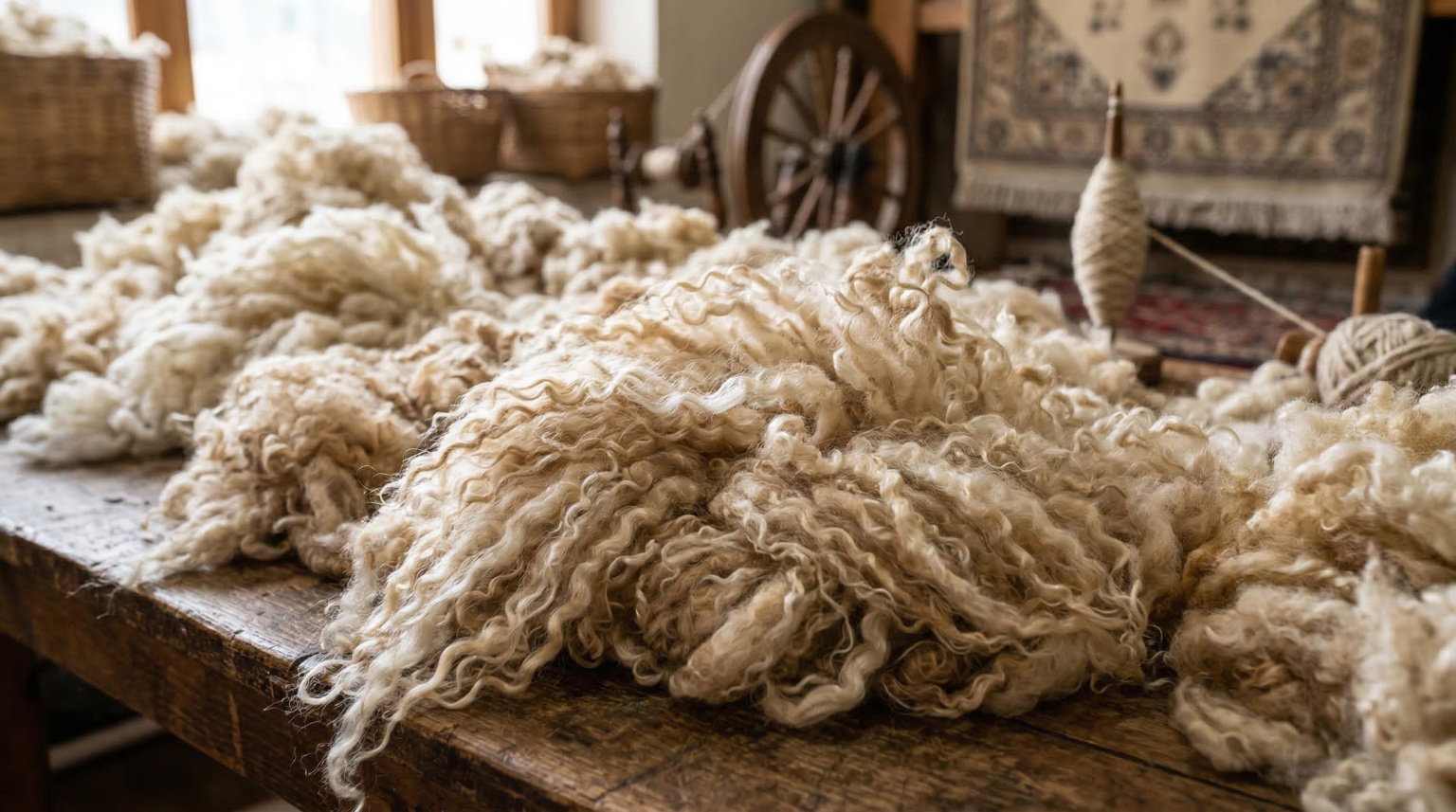
The quality of a wool rug begins long before the loom. It begins with the animal, the altitude at which it grazes, the season in which it is shorn, and the part of the fleece from which the fibre is taken. These variables are not incidental. They determine the staple length, the crimp frequency, the natural lustre, and the tensile strength of the individual fibres — properties that translate directly into the quality of the finished pile.
The most prized wools in the carpet-making tradition come from sheep raised at high altitudes, where cold temperatures and sparse grazing produce fibres of exceptional fineness and natural strength. New Zealand wool is celebrated for its consistent quality and bright white base, which accepts dye with particular clarity. Ghazni wool from Afghanistan, harvested from the fat-tailed Qaraqul sheep of the Hindu Kush highlands, has a natural lustre and a long staple that allows skilled spinners to produce yarn of remarkable smoothness. Tibetan highland wool, with its high lanolin content, produces a pile of distinctive softness and natural sheen that no lowland equivalent can replicate.
The clip itself matters enormously. Spring wool, taken from animals that have grazed through winter, tends to be longer, stronger, and more lustrous than summer clip. The best carpet wools are sorted by hand after shearing, separating the finest fibres from the coarser belly wool and leg wool that would produce a less refined pile. In workshops producing rugs of genuine ambition, this sorting process is as rigorous as any subsequent stage of production — a recognition that the character of the finished piece is already latent in the raw material.
The Alchemy of Natural Dye
Wool has an affinity for natural dye that synthetic fibres cannot approach. The protein structure of the fibre — the same keratin that constitutes human hair — bonds with natural mordants and dye compounds in a way that produces colours of exceptional depth, complexity, and, critically, longevity. A wool rug dyed with natural indigo, madder root, pomegranate rind, or walnut husk will not simply retain its colour over decades; it will develop it. The phenomenon known as abrash — the subtle, irregular variations in tone that occur across a hand-dyed pile — is not a flaw but a quality marker: evidence that each skein of yarn was dyed individually, by hand, in small batches that could never be perfectly replicated.
Natural dyes do not simply colour wool — they enter into a relationship with it. The colour that emerges twenty years after weaving is never quite the same as the colour at the loom, and it is almost always more beautiful.
The move away from natural dyes in the mass-production era was driven entirely by economics. Synthetic dyes are cheaper, faster, more consistent, and easier to control at volume. What they cannot replicate is the tonal richness of a colour that has been built from botanical and mineral sources over centuries of accumulated knowledge. A synthetic red sits on the surface of the pile. A madder red lives inside the fibre. The difference is visible to any eye that has spent time with both.
Hand-Knotting: The Architecture of the Pile
The technical heart of a fine wool rug is its construction. Hand-knotted rugs are built knot by knot, each individual tuft of pile yarn tied around the warp threads of the loom and then cut to height. The density of these knots — expressed as knots per square inch or per square decimetre — is the primary structural variable that determines the fineness of the design, the precision of the pattern's edges, and the longevity of the pile under use.
A coarsely knotted rug of, say, 40 knots per square inch has a pile that wears relatively quickly and a design resolution that limits the intricacy of achievable patterns. A finely knotted piece at 400 knots per square inch produces a surface of near-photographic resolution, capable of rendering complex curvilinear designs, shaded colour fields, and figurative imagery with remarkable clarity. Between these extremes lies the range within which most serious hand-knotted wool rugs are produced — and within which the differences in quality, cost, and aesthetic achievement are enormous.
The knot count alone, however, does not determine quality. The tension of the knotting, the evenness of the pile height, the precision with which the weaver has followed the design cartoon, the quality of the finishing — the clipping, washing, and stretching that bring the completed rug to its final state — all contribute equally to the standard of the finished piece. The finest workshops in India and Turkey, which have sustained hand-knotting traditions across many generations, understand that these processes cannot be hurried without cost to the result.
The Indian Tradition: Rigour and Refinement
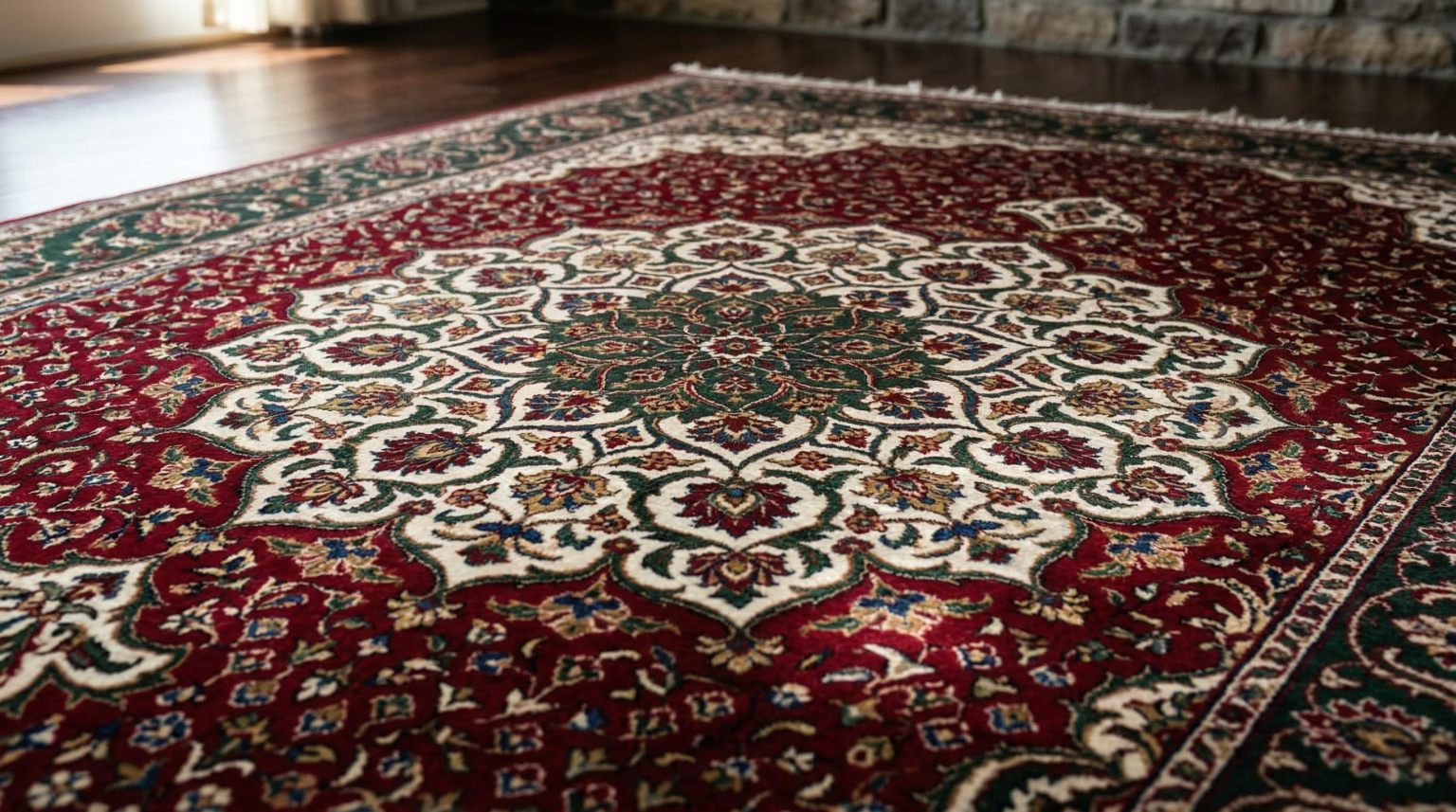
India's carpet-weaving tradition, centred on the workshops of Jaipur, Agra, and the villages of Uttar Pradesh, represents one of the great concentrations of textile skill in the world. Introduced to the subcontinent by the Mughal emperors of the 16th century, who brought master weavers from Persia to establish court workshops of extraordinary ambition, the Indian tradition developed over four centuries into a practice of remarkable diversity and technical sophistication.
Contemporary Indian rugs from the finest producers combine the inherited formal vocabulary of the Mughal carpet — the elaborate floral medallion, the densely populated border, the jewel-like colour palette — with modern design sensibilities and the demands of an international luxury market. The best Indian workshops today work with designers of genuine ambition, producing pieces in which traditional techniques serve entirely contemporary visions. The result is a category of object that is simultaneously rooted in one of the world's richest craft traditions and entirely alive to the present moment.
The Turkish Tradition: Geometry as Language
If the Indian carpet tradition is characterised by floral abundance and painterly refinement, the Turkish tradition speaks a different aesthetic language altogether. The great weaving regions of Anatolia — Hereke, Konya, Oushak, Gördes — each developed distinctive formal vocabularies over centuries of production: bold geometric patterns, strong contrasts of tone, a graphic directness that reads with authority even at a distance.
Hereke, the workshop established by Ottoman Sultan Abdülmecid I in the mid-19th century to supply the imperial palaces, produced some of the finest hand-knotted silk and wool rugs in the world — pieces of such technical density and material quality that they remain, a century and a half later, the benchmark against which all subsequent Turkish production is measured. The Oushak tradition, by contrast, developed a palette of soft, faded golds and terracottas and a looser, more meditative pattern language that has proved enormously influential on Western interior design.
The Anatolian weaver did not decorate a surface. She constructed an argument — geometric, spatial, and deeply considered — that could be read from any angle and at any distance.
Contemporary Turkish rugs from serious producers maintain this tradition of formal intelligence whilst adapting it to the demands of modern interiors. The finest examples bring together the graphic authority of the Anatolian geometric tradition, the material quality of hand-spun highland wool, and a colour knowledge refined over generations of natural dyeing practice. In a room of minimal architecture, a strong Turkish geometric grounds the space with precisely the kind of visual certainty that more restrained floor treatments cannot provide.
What Luxury Wool Feels Like Underfoot
All of the foregoing — the provenance of the fibre, the quality of the dye, the density of the knotting, the skill of the weaver — converges at the moment of daily experience: the moment when bare feet meet the pile. This is where the distinction between a luxury wool rug and a merely serviceable one is most immediately apparent, and most difficult to articulate in technical terms.
High-quality wool pile has a resilience that is fundamentally different from the compressive softness of a synthetic alternative. It yields underfoot and returns. It retains its pile height under sustained use because the fibre's natural crimp gives it an inherent spring that synthetic fibres, which deform plastically under pressure, do not possess. It regulates temperature with a subtlety that makes it warm in winter and not oppressively so in summer. It does not generate static. It naturally resists soiling, and when it does mark, it cleans with a ease that reflects the fibre's low surface energy.
Over years and decades of use, the finest wool rugs develop a surface patina — a gentle flattening and brightening of the pile — that is quite different from wear and entirely distinct from degradation. The colours deepen and integrate. The surface acquires a soft sheen. The rug becomes, in the truest sense, more itself. This is the quality that distinguishes wool from every synthetic alternative: not merely how it performs, but how it ages. It is the quality that makes a serious wool rug an investment in the fullest sense of that word rather than a purchase in the merely transactional one.
Selecting with Seriousness
For those approaching the acquisition of a significant wool rug as the deliberate act of collection it deserves to be, the range available at the level of genuine quality is both broader and more demanding than casual browsing suggests. The category of luxury rugs encompasses an extraordinary diversity of tradition, technique, and formal language — from the densely knotted Mughal florals of Jaipur to the bold geometric fields of Anatolia, from the abstract expressionism of contemporary designer pieces to the time-worn authority of carefully sourced antiques.
What unites the finest pieces across this diversity is not a single aesthetic but a consistent standard of material and making: wool of genuine provenance, dyed with honesty and skill, knotted by hands that have spent years mastering the form. These are the properties that make a rug worth living with — not for a season or a decade, but for a lifetime and beyond. The wool rug, at its finest, is not a floor covering. It is an argument for the enduring value of things made with full seriousness, by people who understand that beauty and longevity are not in competition but are, in the most important objects, the same quality expressed twice.