
The Oversized Rug: How Going Large Became the Defining Move in Contemporary Interiors
For a long time, the conventional wisdom about rugs was cautious. Choose something that fits comfortably within the furniture grouping. Leave a generous border of floor visible around the edges. Avoid anything that might overwhelm the room. It was advice rooted in a particular anxiety about commitment — the fear that a large, expensive, visually dominant object might prove to be a mistake. The result, in countless otherwise well-considered interiors, was rugs that looked like islands: isolated, tentative, and oddly disconnected from the rooms they were meant to complete.
That consensus has shifted decisively. Across the range of design practices producing the most compelling interiors today — from the spare, architecturally rigorous to the layered and richly decorative — the move towards generous scale is consistent and deliberate. The oversized rug is no longer a bold choice; it is increasingly the obvious one. Understanding why requires looking at what a rug of proper scale actually does to a room, and why that effect has become so central to the contemporary interior.
The Room Within the Room
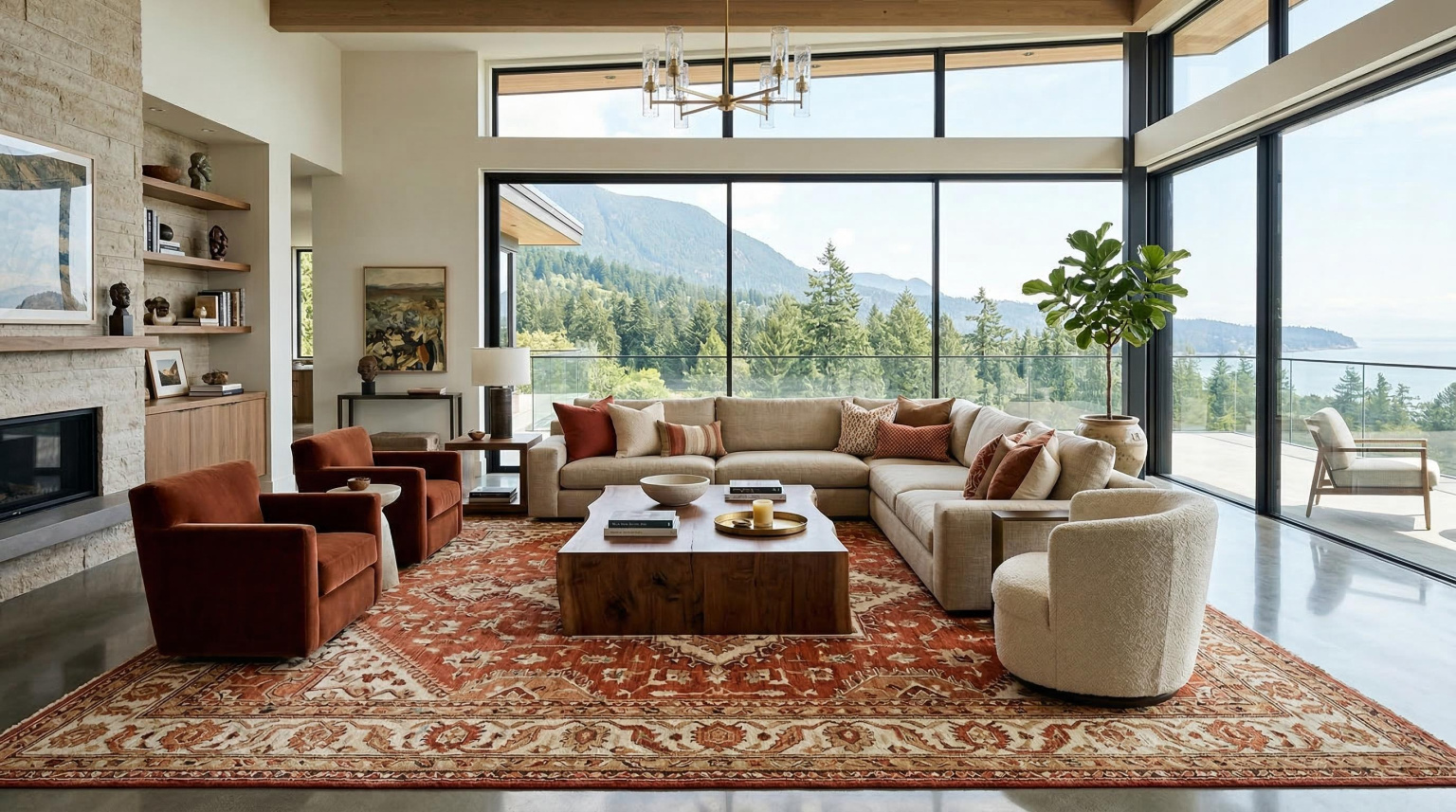
The most immediate effect of a generously proportioned rug is one of spatial definition. In open-plan living spaces — the dominant residential typology of the past two decades — the oversized rug performs a function that no other single object can replicate: it creates rooms within rooms, carving habitable zones from undifferentiated floor area with a precision and warmth that partition walls and furniture arrangements alone cannot achieve. A rug that extends beneath the front legs of every sofa in a seating grouping, and reaches to within comfortable distance of adjacent walls, tells the room where it is. It gives the space a centre, a boundary, and a reason for the furniture's arrangement that feels organic rather than imposed.
This spatial function is particularly valuable in the kind of large, architecturally minimal spaces that characterise high-specification contemporary living. In a room where the floor plane is vast, the ceiling is high, and the walls are largely glazed, the introduction of an extra large rug of strong visual character does not reduce the sense of space — it articulates it. The room becomes legible, its proportions apparent and human rather than simply impressive. The rug does not fill the space; it makes the space comprehensible.
Scale and the Perception of Luxury
There is a less frequently articulated reason why oversized rugs have become so central to the vocabulary of luxury interiors, and it has to do with what generosity of scale communicates about a space and its inhabitants. A rug of genuinely commanding dimensions — one that has been chosen with full awareness of its cost, its visual weight, and its dominance in the room — signals a different relationship to the interior than a more cautious selection. It communicates commitment, confidence, and a willingness to invest in quality at the level of the room's most fundamental elements rather than its easily replaceable accessories.
This is not a trivial distinction. In the market for significant interiors, the quality of the floor treatment is one of the most reliable indicators of the overall standard of investment. A beautiful rug of proper scale suggests that everything above it has been given equivalent thought. A small or compromise rug, however expensive the furniture it sits beneath, suggests the opposite: that the floor was an afterthought, and that the interior as a whole may share that quality of incomplete attention.
The Case for Round: A Different Kind of Authority
Within the broader movement towards generous scale, the large round rug deserves particular attention. It is, in several respects, the most demanding format: it imposes a geometry on the room that is non-negotiable, drawing the eye to a circular centre that organises the furniture around it with a formality that rectangular rugs do not inherently possess. Used well, this quality is precisely its strength.
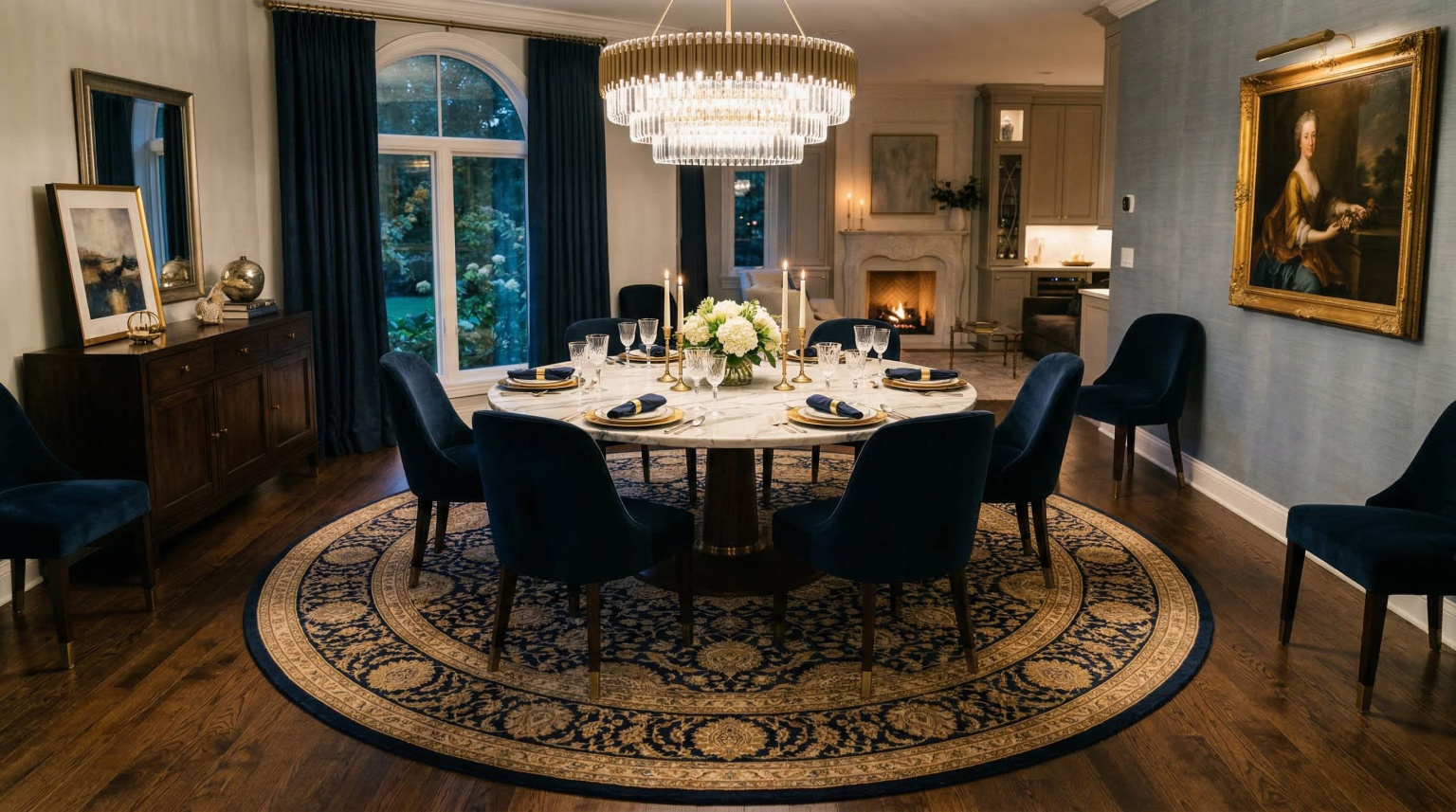
In dining rooms, the round rug beneath a circular or oval table creates a composition of concentrated elegance — a room within the room that declares itself with quiet authority. In entrance halls and reception spaces, where the first impression of an interior is established, a large circular rug reads as a deliberate act of design rather than a floor covering. In sitting rooms composed around a central coffee table, the round format anchors the arrangement in a way that feels simultaneously more intimate and more resolved than a rectangular alternative.
The best extra large round rugs reward the courage of their format with a visual presence that rectangular pieces of equivalent quality and dimension rarely match. The circularity focuses attention; the scale commands it. For rooms where a single, definitive gesture is the correct design decision, this combination is difficult to surpass.
Material and Construction: Why Scale Demands Quality
There is a practical argument embedded within the aesthetic one. A rug of generous dimensions occupies more of the room's visual field than any other single object. Its colour, texture, and condition are constantly apparent, impossible to overlook, and registered at a level of detail that smaller textiles are not. This means that the quality of the material and the precision of the construction are more exposed in a large rug than in almost any other category of interior object. Flaws that might be forgiven in a small accent rug become significant in a piece that covers eight square metres of a principal reception room.
The implication is straightforward: scale and quality are not independent variables. A large rug made from inferior materials will read as a large inferior rug — and will degrade in a manner that a smaller piece might manage to conceal. The commitment to generous scale must be accompanied by an equivalent commitment to material excellence. Hand-knotted pile in wool, silk, or a considered combination of the two; natural dyes or high-quality synthetic alternatives that maintain their depth over decades; construction dense enough to hold its pile and shape under sustained use: these are the properties that make a large rug a long-term investment rather than a large short-term expense.
For those approaching this investment seriously, the range of designer rugs produced by the most significant names in contemporary carpet design offers a useful calibration of what quality at genuine ambition actually looks like. Pieces from this category bring together the formal intelligence of serious design, the technical mastery of specialist weaving traditions, and the material quality that large scale demands.
Choosing the Pattern: Visual Weight at Scale
The relationship between pattern and scale in rugs is one of the more counterintuitive aspects of their selection. The instinct, when choosing a large rug for a significant room, is often to favour restraint: a plain field, a subtle texture, a design that will not compete with the furniture above it. This reasoning has a partial validity — a rug that overwhelms rather than anchors its room is a failed choice, regardless of its individual quality. But the conclusion it leads to is frequently mistaken.
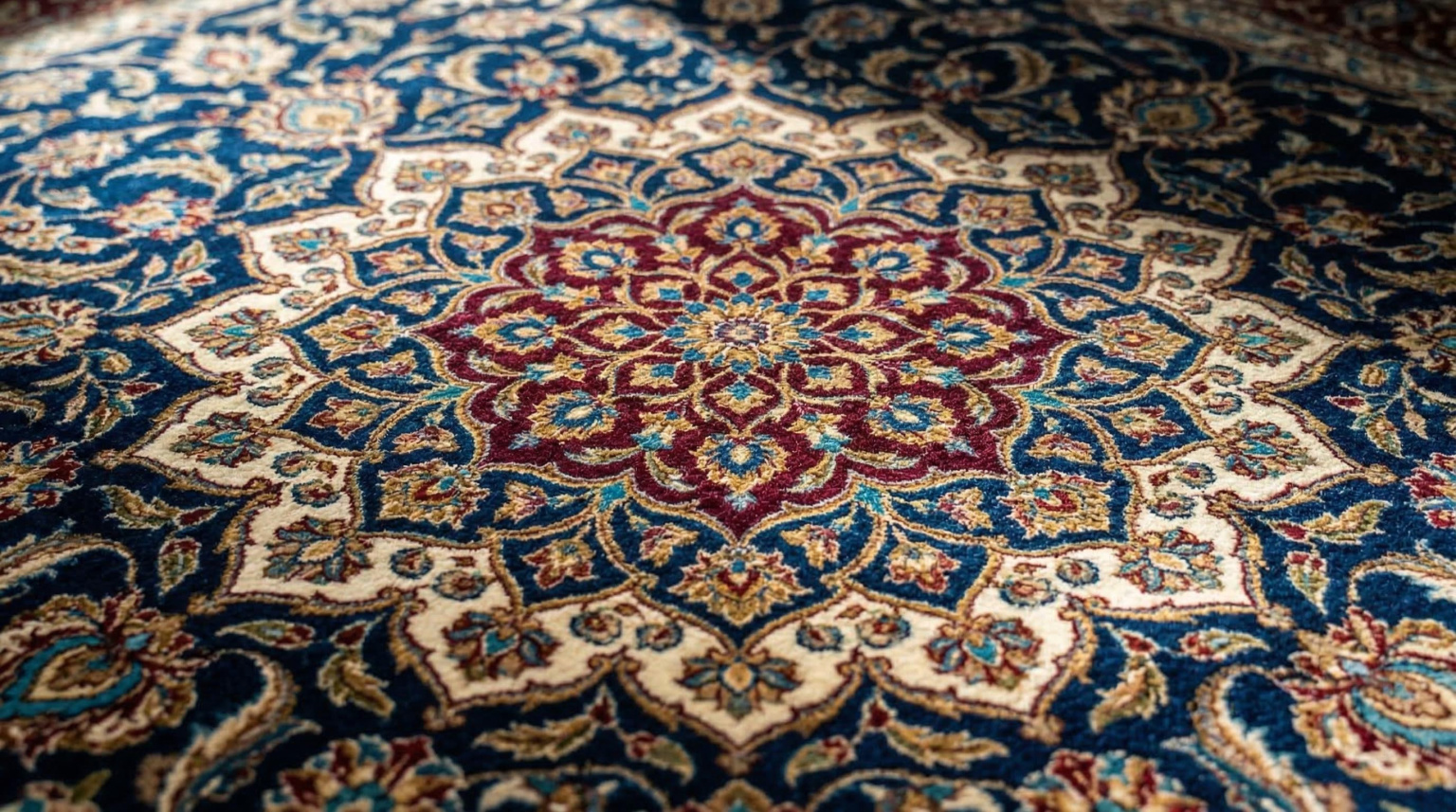
A plain or near-plain rug of large dimensions has a particular visual weight: the expanse of unbroken surface draws attention to any inconsistency in the pile, any variation in dye, any mark or shadow. At large scale, plainness is not neutral; it is exposed. A design with genuine compositional intelligence — a field pattern of sufficient complexity to reward the eye without dominating it, a border that resolves the transition to the floor beyond, a central medallion that provides orientation without rigidity — handles the demands of scale more gracefully. The pattern does not compete with the furniture; it provides the visual infrastructure that allows the furniture to be read clearly.
The most successful large-format rugs are those whose design was conceived for their scale, rather than extrapolated from a smaller format. The pattern breathes at large dimensions; the border functions as it is intended to; the overall composition reads as a whole rather than as a detail enlarged. This is one of the most reliable distinctions between rugs designed by people who understand the form and those designed primarily for reproduction at whatever size the market demands.
Placement: The Decisions That Determine Everything
A rug of excellent quality and proper dimensions can still fail to achieve its full effect through errors of placement. The most common is positioning the rug too far from the walls it is adjacent to, leaving excessive bare floor at the perimeter and undermining the spatial definition the rug is there to create. In a principal sitting room, a gap of 30 to 45 centimetres between the rug's edge and the skirting board is generally appropriate; more than this, and the rug begins to float rather than anchor.
Equally important is the relationship between the rug and the furniture above it. The conventional rule — front legs of all seating pieces on the rug — is a reliable starting point, but in rooms furnished with pieces of genuine scale, the more resolved solution is often to have the rug extend fully beneath all seating, with the furniture sitting entirely within its boundaries. This approach produces a more unified composition and makes the spatial zone the rug defines more legible and more generous.
Layering, increasingly a feature of the most considered contemporary interiors, introduces further possibilities. A large flat-weave or natural-fibre rug as a base layer, with a smaller, more intricately worked piece placed above it, creates depth and textural richness whilst allowing both pieces to be appreciated individually. The scale relationship between the two layers is critical: the base must be genuinely generous for the upper piece to read as an intentional addition rather than a correction.
The Rug as Collecting Practice
For those who approach their interiors as collectors rather than merely as decorators, the large rug occupies a category of its own. Hand-knotted carpets of genuine quality and significant size are among the most labour-intensive objects in the world of decorative art: a skilled weaver may spend months on a single piece, tying hundreds of thousands of individual knots to produce a surface of perhaps twelve square metres. The mathematics of this process — the time, skill, and material it represents — are reflected in the objects themselves, which carry a density of craft that is immediately apparent to anyone who has spent time with the finest examples.
These are not pieces that are selected quickly or replaced casually. They are chosen with the understanding that they will define a room for years or decades, that they will be seen daily by the people who inhabit that room, and that their quality will either reward or reproach that daily attention. This is, ultimately, the most compelling argument for going large: not that an oversized rug makes a room look more impressive, but that a rug of genuine quality and proper scale makes a room better to live in. More resolved, more habitable, more itself. The geometry of daily life, conducted on a surface that was made with full seriousness, takes on a different quality. The room that contains it becomes, in the fullest sense, a room worth being in.