
Teak Wood in Modern Interior Design
There are materials that decorate a room, and there are materials that define it. Teak belongs to the second category — and has done so, across continents and centuries, with a consistency that few natural substances can rival. Its colour deepens with age rather than fading. Its grain, close and even, holds a carved edge as cleanly as the day it left the workshop. Its oils repel moisture, insect, and time with an equanimity that makes most other timbers seem fragile by comparison. In an era of interiors that celebrate the authenticity of material and the intelligence of craft, teak has not merely survived — it has become, once again, the timber of choice for designers and collectors who understand that genuine quality is not a trend.
A Material with a Biography
Teak (Tectona grandis) is native to the monsoon forests of South and Southeast Asia — Myanmar, Thailand, India, Java — where it evolved over millennia to withstand conditions that would destroy lesser timbers. The very properties that made it indispensable to shipbuilders and temple architects for thousands of years are precisely those that make it so valuable in the contemporary interior: exceptional dimensional stability, natural resistance to warping and cracking, and a density that translates directly into the satisfying weight and solidity of a well-made piece of furniture.
Teak entered the European consciousness through the spice trade and the age of sail, when its presence in the hulls and decks of ocean-going vessels was practically obligatory. The colonial bungalows of British India, the plantation houses of Java, the merchant palaces of Goa — all relied on teak for their structural and decorative timber, producing a building tradition whose interiors combined European proportion with the sensuous warmth of South Asian craft. It is that combination — rigour and warmth, structure and beauty — that the finest contemporary teak furniture continues to embody.
The Aesthetics of Teak: What the Eye and Hand Find
What distinguishes teak visually is the particular quality of its grain and the extraordinary range of its natural colour. Freshly worked, it ranges from a warm honey-gold to a rich amber-brown, with darker streaks that follow the growth rings and give each plank its individual character. Left to age naturally or treated with teak oil, it deepens into the richer, more complex tones that collectors recognise as the mark of a fine old piece. Exposed to outdoor light, it weathers to a distinguished silver-grey — a patina that, far from diminishing the material, gives it the beauty of something that has genuinely lived.
To the hand, teak has a quality that is difficult to articulate but immediately recognisable: a smoothness that is somehow also substantial, a surface that reads as warm even when the room is cool. This is partly the natural oil content of the wood, which gives it a slight lustre even unfinished. It is also, partly, a matter of density — teak furniture has a presence, a gravity, that lighter timbers simply cannot replicate. When you close a teak drawer or set a teak tabletop with glasses, the sound alone tells you something about the quality of what you are holding.
Teak in the Modern Interior: Three Approaches
Contemporary designers working with teak tend to fall into one of three approaches, each producing interiors of very different character but equally compelling.
The first is the reductive approach: teak used with near-Japanesque restraint, where a single piece — a long dining table with legs of squared teak, a bed platform of book-matched planks — is given space to assert itself against plaster, stone, or concrete. Here, the grain of the wood becomes the room's primary visual event. Nothing competes; the material is given full authority to speak.
The second is the architectural approach: teak integrated into the fabric of the room itself — as wall panelling, as ceiling cladding, as built-in shelving and cabinetry. In this mode, the warmth and richness of the timber moderate the severity of otherwise minimal architecture, producing spaces that feel simultaneously rigorous and inhabitable. The finest expression of this approach can be found in the work of designers who understand that teak's role is not to decorate a room but to temper it — to bring the warmth of the organic into spaces that might otherwise read as cold.
The third is the eclectic approach: teak furniture placed in conversation with contrasting materials — marble, linen, leather, lacquer — where the wood's warmth provides the anchoring note in a more complex composition. This is perhaps the most demanding approach, requiring a precise understanding of how teak's tonal range interacts with other surfaces. Done with confidence, it produces interiors of extraordinary richness.
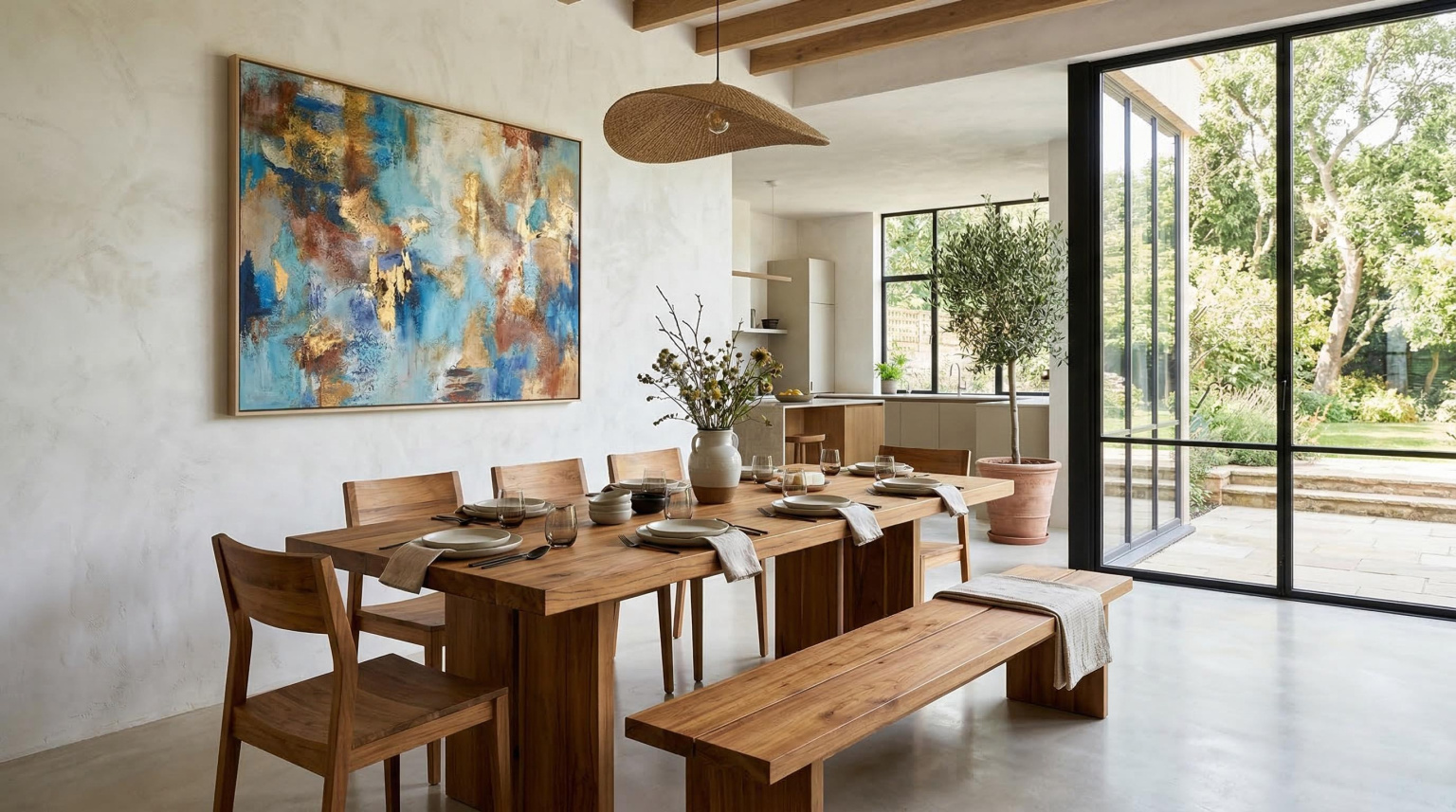
The Dining Table: Teak's Finest Expression
If there is one piece of furniture in which teak achieves its fullest expression, it is the dining table. The table is the piece around which a household organises its most significant rituals — meals, conversation, work, celebration — and it is the piece that, more than any other, must endure. A teak dining table, properly made from sustainably sourced solid timber, will outlast its owners. Book-matched tops reveal the bilateral symmetry of the grain in a way that reads as genuinely architectural. Extensions in solid teak rather than veneered MDF maintain the integrity of the surface whatever the configuration. The finest examples — those with hand-finished surfaces and joints that have been given the time they require — are pieces that acquire meaning with each passing year.
The range of tables available to the contemporary collector spans a remarkable breadth of design vocabulary: from the spare, rectilinear forms of Scandinavian modernism to the more expressive, live-edge pieces that celebrate the individuality of the plank, from the architectural rigour of Japanese joinery traditions to the fluid curves of mid-century Italian design. What unites the finest examples, regardless of their formal language, is an integrity of material and construction that no amount of surface treatment can fabricate — the quality that only comes from starting with exceptional timber and working it with genuine skill.
Storage, Display, and the Architecture of the Wall
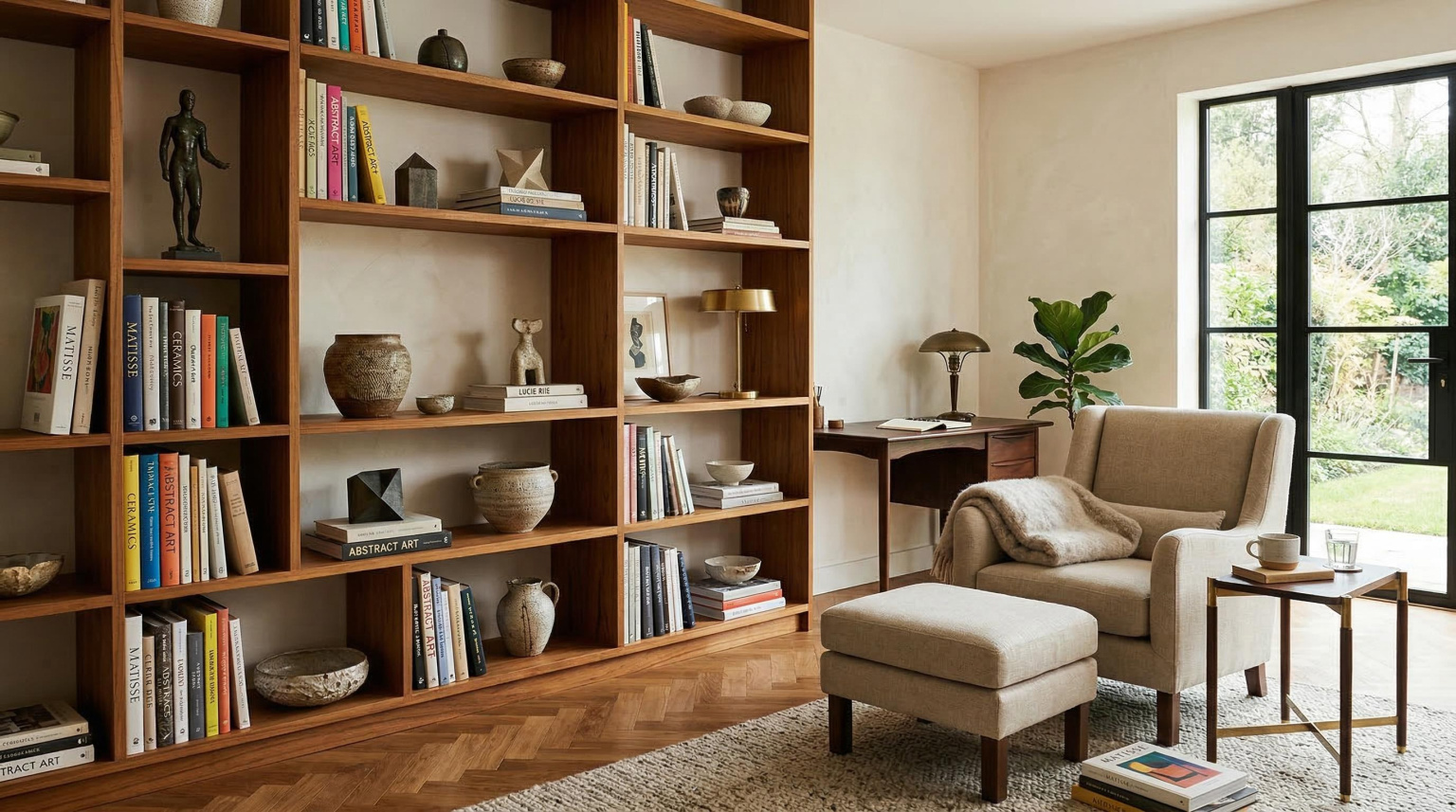
Beyond the dining table, teak finds its most architecturally significant expression in the pieces that structure a room's vertical plane: the bookcase, the display cabinet, the shelving system. These are the pieces that define how a room is inhabited over time — what is kept, what is shown, how a collection is organised and revised. A bookcase is not merely storage; it is, in the finest interiors, a self-portrait in three dimensions, and the material from which it is made contributes materially to the quality of that portrait.
Teak bookcases — particularly those built with the precision and ambition characteristic of Italian cabinet-making traditions — bring to the wall a presence that painted MDF or powder-coated steel cannot match. The depth of the grain, the warmth of the colour, the way the light moves differently across an open-grained surface as the day progresses: these are qualities that reward daily habitation in a way that purely functional storage never can. The Italy bookcases collection represents this tradition at its most considered — pieces in which the precision of Italian joinery and the beauty of carefully selected teak produce furniture that functions as interior architecture rather than mere cabinetry.
Teak and Sustainability: The Question That Must Be Asked
Any serious discussion of teak in the contemporary interior must address the question of provenance. The timber's exceptional qualities made it one of the most heavily exploited woods of the 20th century; the old-growth forests of Myanmar and Southeast Asia that once supplied the global market have been dramatically depleted by decades of unregulated logging. This history makes sustainable sourcing not merely an ethical preference but a fundamental criterion of quality: old-growth teak from questionable sources is not only environmentally indefensible — it is increasingly a marker of low standards rather than high ones.
The finest contemporary teak furniture is made from plantation-grown timber, produced under FSC certification in Indonesia, Costa Rica, and other countries where responsible forestry management has developed over decades. Plantation teak, harvested at 25 to 40 years rather than the 80-plus years of old-growth specimens, has a slightly less dense grain — but in the hands of skilled designers and craftsmen, this is managed rather than apologised for. Reclaimed teak — salvaged from demolished colonial-era buildings, old railway sleepers, or decommissioned vessels — is the most environmentally compelling option of all, and produces furniture of incomparable character: timber that carries a century or more of life in its grain.
Pairing Teak: The Materials That Speak Its Language
Teak is an exceptional collaborator. Its warm amber-brown register works in dialogue with an unusually broad range of other materials, and understanding these relationships is one of the more pleasurable aspects of working with it in a serious interior.
Against stone — particularly the cool greys and creams of limestone, travertine, and marble — teak provides precisely the warmth that prevents the interior from reading as clinical. The contrast between the softness of wood grain and the crystalline precision of polished stone is one of the most satisfying in the decorative vocabulary; it appears in the finest interiors across every period and culture for good reason. Against linen and undyed cotton, teak reads as organic and grounded, producing a textural register of great subtlety. Against leather — particularly the dark, aged leathers of a well-used sofa or a traditional library chair — it achieves a richness that has few equals. Against brass and unlacquered bronze, the warm yellow undertones of both materials create a harmony that feels simultaneously ancient and entirely contemporary.
The Long Argument for Quality
The most compelling case for teak in the modern interior is ultimately a temporal one. We live in an era of accelerated obsolescence — of furniture conceived for a single decade and designed to be replaced rather than repaired. Teak makes the opposite argument, quietly and with great authority. A teak dining table made to a high standard will be as beautiful in fifty years as it is today — more so, in all likelihood, as the grain darkens and the surface accumulates the evidence of use. A teak bookcase will outlast the library it houses and the house it inhabits. These are not merely sustainable choices in the environmental sense, though they are that too. They are arguments for a different relationship with objects — one founded on genuine quality, genuine pleasure, and the understanding that the things we live with every day are worth taking seriously.